This drawing 13-year-old boy made it; the mother abandoned him after birth, so he was placed in a foster home.
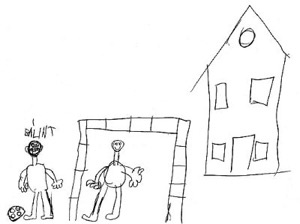
In the kinetic school drawing we asked: "draw yourself at school, with your teacher and one or two friends, so that everyone is doing something!"
(Learn this method in practice too at the live projective drawing interpretation course »)
In the drawing, the figure standing in the gate is the subject, next to him his friend ("Balint"). No teacher (which is an unusual phenomenon), the school visible from outside - which is likewise unusual, because most children depict the school from inside.
A further conflict signal is that the activity, the football is not connected with closely with the school or with learning.
I quote from the pedagogical opinion:
- He escaped from the institution several times and became acquainted with suspicious figures, with whom he also lived.
- In school lessons his behaviour is often provocative, for example he jumps about on benches, throws chairs and overturns benches.
- His relationship with his peers is fluctuating. He is bound to his friend by a close bond, "which from time to time it comes unravelled and culminates in a dangerous fight full of affect”.
After this it is very interesting that the subject encapsulates* himself with a double line (see below), turns smiling towards his friend, who, however,he pulls an angry faceand turns away from him (relational ambivalence).
*During encapsulation the subject encircles one or more figures with lines. Several interpretations are possible, which must be carefully distinguished.
What is the kinetic school drawing for?
The kinetic school drawing shows how the child feels at school, or in the company of other children.
It sincerely uncovers what the child's self-esteem is like, how he relates to school and to learning, and, in a more general sense too, how he feels in his own skin?
In the form of an individual examination, it presents
- the perception of the teacher, the companions and the school,
- how the child feels among his peers,
- what his relationship is to authority, rules, external expectations,
- what their identification patterns are like and
- it gives a signal about possible learning or performance problems.
The analytic aspects of the group examination show
- how the pupils see each other and the teacher,
- what typical actions the teacher performs from the children's point of view,
- what it provides a model for and
- what her relationship with the children is like.
The test can also be applied for group screening.
Recommended Hungarian-language literature:
Vass, Z., & Perger, M. (2011). A kinetikus iskolarajz. Iskolapszichológia 32. Budapest: ELTE Eötvös Kiadó (77 pp.)