A manic patient or a hyperactive child?
Reading time: 2 minutes 34 seconds
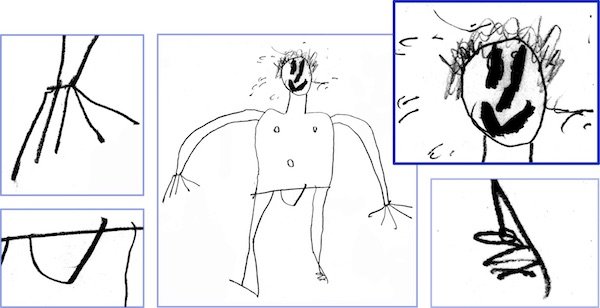
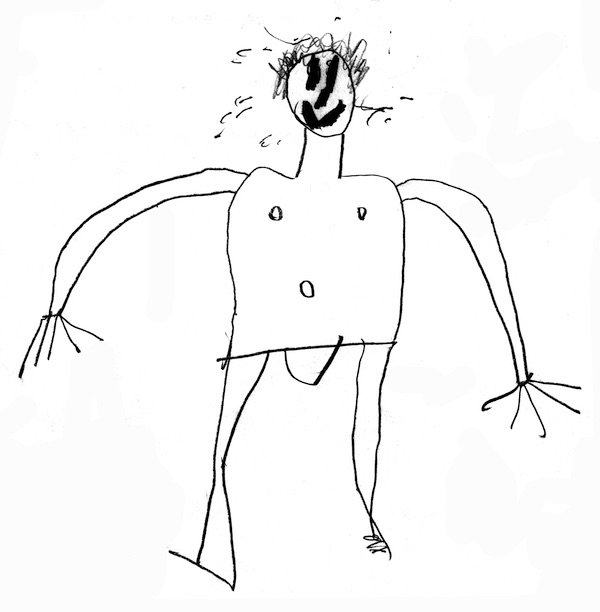
The above picture presents a very rare drawing.
It is rare because it is difficult to decide whether an adult or a child drew it (whereas at other times this is an easy task).
Try it yourself too! I'll help: what do you think, could it be that...
- it is a matter of the drawing of a hyperactive child,
- or about an adult manic-depressive patient?
The drawing proved so interesting that we also put to the test those who count as experts in the field of projective drawing interpretation.
EVEN THE EXPERTS could not decide
At one time we regularly presented the above drawing at scientific conferences, to highly trained experts:
- for psychiatrists,
- for clinical specialist psychologists,
- for consultants in the psychology of pictorial expression,
- to art therapists,
...or to the members of the Expression-Pathology and Art-Therapy section of the Hungarian Psychiatric Association,
... furthermore to those who have completed the The trainings of The SSCA Method.
We put to them literally the question read in the title.
As a comparison, we asked the same from naive judges too.
The result was around 50-50% for both answers, whether we showed the drawing to experts or to naive interested parties.
This means that you guessed at random!
If neither the experts nor others hit on the correct answer beyond chance probability, then we can only think that ....
... the task is unsolvable. The problem is not with the experts. The drawing above simply does not carry the sought information!
WHY CAN IT NOT BE GUESSED?
It is generally easy to decide about a drawing whether a child drew it.
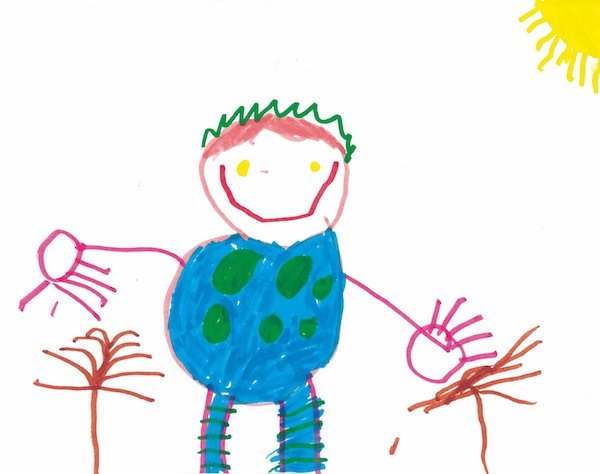
Children's drawings possess formal and content signs that have developmental-psychological roots and are generally unambiguous.
The solution is especially easy if about a classic drawing test is involved.
For a great many studies have already been carried out with the classic drawing tests and a significant body of knowledge has accumulated about them.
This drawing was indeed made in one of the classic drawing tests: in John N. Buck's (1948) House-Tree-Person drawing test.
We can discover the following pictorial features on it:
- quick, 'flitting' lines,
- large size (the figure almost fills the A5 sheet),
- rough elaboration,
- formal distortions,
- a broadly grinning mouth,
- non-conventional details (for example an unidentifiable genital).
If we open the textbooks, we see that these can occur alike
- ... an attention-deficit or hyperactive child in the drawing of (DSM-IV. 314), because they indicate restlessness, impatience, impulsivity, and general adjustment problems,
- ...BUT the manic patient could also have drawn it!! (manic episode of bipolar disorder, DSM-IV. 296), in whom the expansivity, the psychomotor agitation, the abnormally elevated mood, the increased self-esteem, the rushing of thoughts and the crowding of thoughts cause them.
The solution
So what, in the end, is the correct answer?
The drawing, as it happens, a6-year-old, hyperactive little boy drew it at the educational counselling centre, during the school-readiness examination...
...BUT the manic patient could also have drawn it!!
LET US DRAW the conclusion
Drawings exclusively into context can be interpreted placed.
In the drawing examination we call context that information which the picture speak of the circumstances of its coming into being.
For example:
- in what situation the drawing took place,
- whether there was an instruction,
- the person's basic data,
- and numerous other factors.
A drawing without context is like a sentence about which we do not know who said it, when, and what they were responding to with it.
Click here if this interests you in detail too
Such sentences only to misunderstand may be, or, what is even worse, to read into something that is not in it.
You have surely already seen such a a political poster, in which a deliberately badly timed or badly lit photograph of someone is shown, so that every other bad thing can be read into it too.
The situation and the circumstances in which the picture came into being alter the meaning to such an extent that, without knowing them, the picture simply cannot be understood.
This holds equally for the political poster and the children's drawing!
do not judge early
This (that is, the absence of context) is exactly what the so-called "don't judge too early" videos are about.
We are horrified by them or we laugh at them:
In projective drawing interpretation we hold the same:
- do not judge early!!
On the basis of the appearance of the drawing alone, correct decisions cannot be made.
One must know the background and the circumstances of creation (the context) of the drawing.
Whoever, on the other hand, acts correctly, reaches a depth of understanding that would otherwise be inconceivable.
We show examples of this in part II of the article (coming soon).
If you would like to learn the correct interpretation of drawings, then come to the summer lectures:
Cited sources
(c) 2018 The SSCA Method