This website uses cookies in order to operate the site, to make it easier to use, to track activity carried out on the site, and to display relevant offers.
Functional
Always active
The technical storage or access is strictly necessary for the legitimate purpose of enabling the use of a specific service explicitly requested by the subscriber or user, or for the sole purpose of carrying out the transmission of a communication over an electronic communications network.
Preferences
The technical storage or access is necessary for the legitimate purpose of storing preferences that are not requested by the subscriber or user.
Statistics
The technical storage or access that is used exclusively for statistical purposes.The technical storage or access that is used exclusively for anonymous statistical purposes. Without a subpoena, voluntary compliance on the part of your Internet Service Provider, or additional records from a third party, information stored or retrieved for this purpose alone cannot usually be used to identify you.
Marketing
The technical storage or access is required to create user profiles to send advertising, or to track the user on a website or across several websites for similar marketing purposes.
The analysis of kinetic kindergarten and school drawings
The meaning of the kinetic kindergarten and school drawings
Reading time: 1 minute 39 sec
Children spend a great deal of time in the kindergarten, at school: more than with the family.
A great many experiences reach them, which seriously touch their soul. It is impossible to say this in words, and, moreover, many feelings do not even become conscious.
The kinetic nursery and school drawing tells of this honestly, authentically.
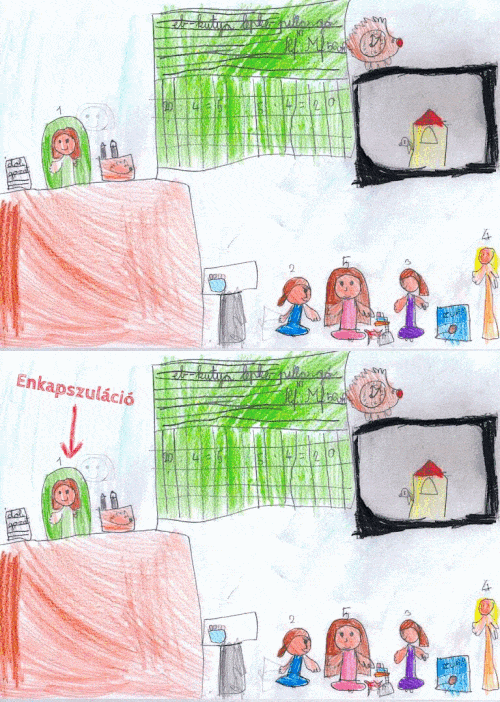
She tells whether the child is teased at nursery (school), who his friends are, how the teacher treats him, whether he is pushed out of the group, whether he endures the time spent there tense and anxious, or whether he has successes?
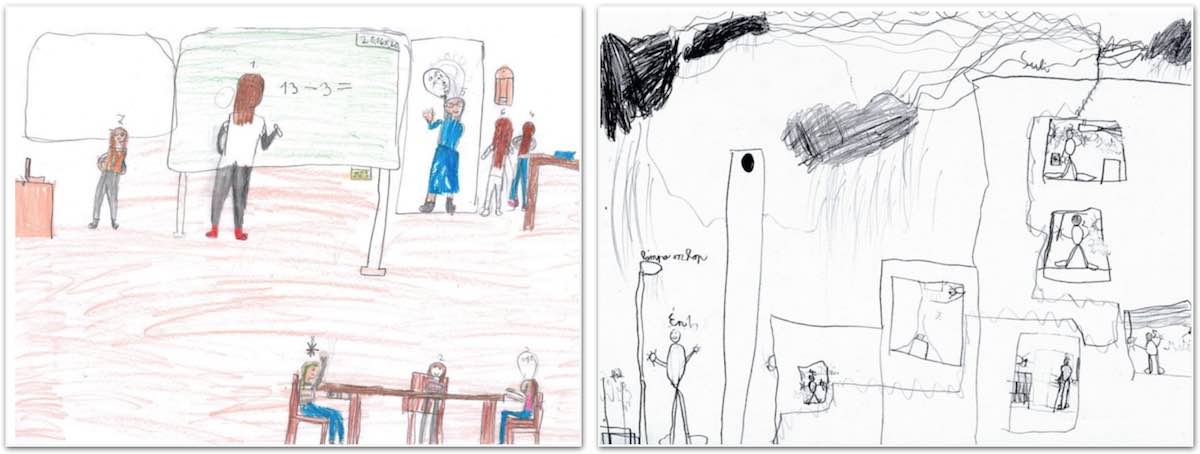
The school drawing of a successful and of a deviant child (the detailed analysis of the drawings features in the Online Tutorial Program of The SSCA Method).
Should one be worried about it, is therapy needed?Is it necessary to speak with the parents, because something is greatly weighing on this child?
The teacher's vocation is very difficult, and demands much self-sacrifice. Moreover, he often faces questions similar to this too.
Does the child fight, have fits of rage? Is he facing a deviant character development? Would it be now that he would truly need a supportive teacher? A psychologist, individual or family therapy?
To whom must it be sent, how serious is the matter?
Either everything is in order, is she just a little anxious and tense? Will it resolve by itself? Should we give her more time?
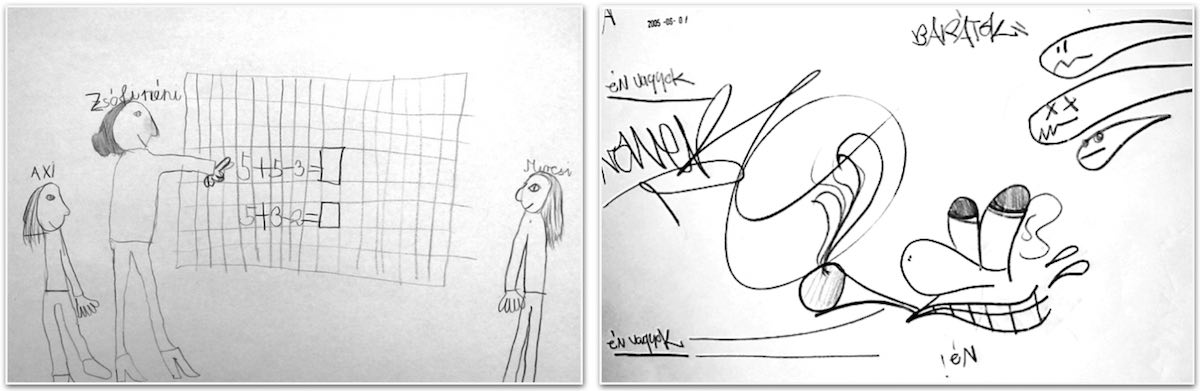
There is no reason to worry about the drawing on the left, but what will become of the maker of the drawing on the right? (a detailed analysis can be found in the study material of the Online Tutorial Program)
Perhaps the trouble is not with the child at all, but with the class dynamics, the parent, or the relationship between the teacher and the group?
Rarely, but it can also happen, that in a group drawing examination the majority of the children draw a shouting, disciplining teacher.
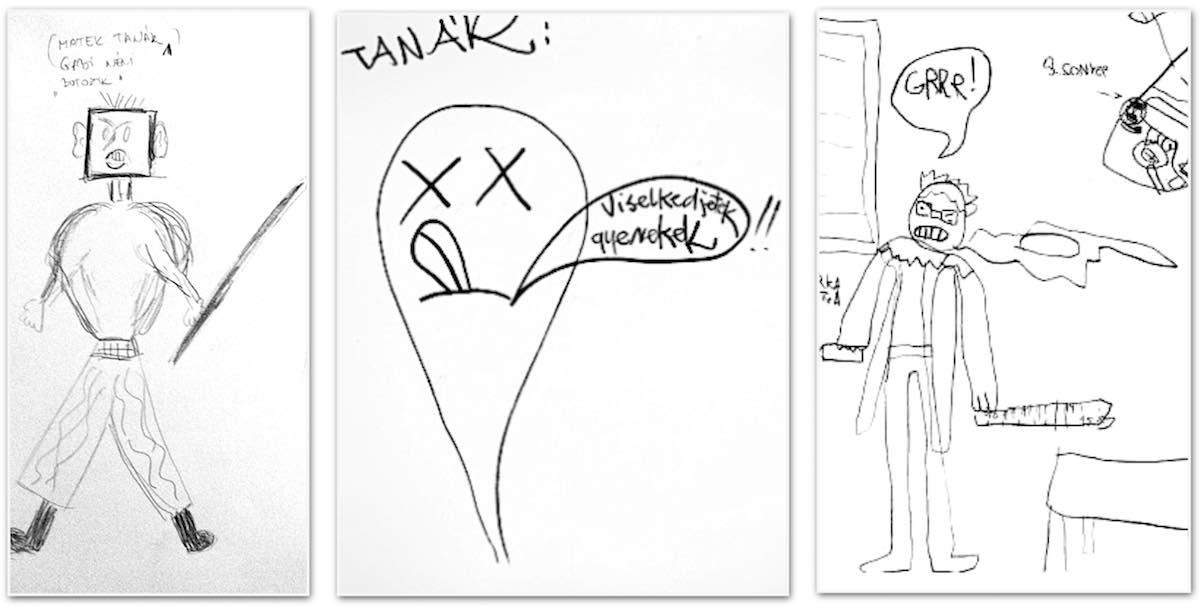
Negative teacher depictions: Auntie Gabi caning, "Behave, children!!" and a teacher with teeth, a cane ("GRRR!")
But it is not worth rushing straight to the director.
It is important to know that even the negative teacher depictions may be much more about the problematic child than about the kindergarten teacher or the teacher; thus it is not certain that the teacher would be at fault in anything!
Then what is the truth, how can it be decided where the root of the problems lies?
Watch this short video:
The 4-minute video below is about this. Watch on what basis Prof. Dr. Vass Zoltán distinguishes the normal and the pathological school drawings:
Why is there a chair in the child's hand? On this 4-minute video you will find the analysis of normal and pathological kinetic school drawings and nursery-school drawings
Such questions to grave decisions may lead, which require thorough orientation and careful weighing.
Never draw a hasty conclusion!
Because of the importance of the topic, The SSCA Method prepared a very detailed interpretation guide for kinetic nursery and school drawings, which can be found in the material of the Online Tutorial Programme.
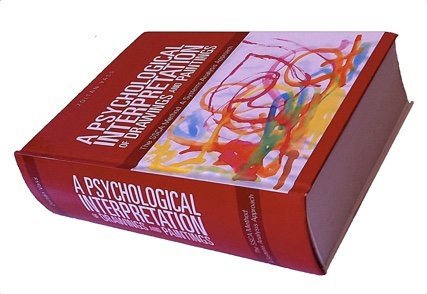
If you are interested, request information about the Online Tutorial Programme at the support@sscamethod.com at the address, or obtain from Tankönyvkiadó the book presented in the video above.
Free download
If this topic interests you, at this link you will find authentic case studies about the kinetic school drawing:
The SSCA Method was founded by Prof. Dr. Zoltán Vass with the aim of supporting the further development of the research field of the psychology of pictorial expression and authentic science communication.
The science of projective drawing interpretation has undergone enormous development in recent decades, since there has appeared the the psychology of pictorial expression a new scientific paradigm, in the wake of the research of Prof. Dr. Zoltán Vass (on which he gave a plenary lecture at the Hungarian Psychological Society).
Unfortunately, in most institutions there is still such outdated methods professionals use, which represent the scientific level of the 1950s.
These should no longer be used today.
In contrast to the now-superseded methods, The SSCA Methodmodern,would like to make the scientific approach accessible to professionals.
Read about Prof. Dr. Zoltán Vass here
Prof. Dr. Zoltán Vass head of department and university professor, author of 20 books and 400 scientific publications, board member of the International Society for Psychopathology of Expression and Art Therapy, and president of the Expression Psychology Section of the Hungarian Psychological Association.
His research and books have become course material at every Hungarian university that trains psychologists and at numerous training institutions abroad.
His most important works:
Vass, Z. (2003). The psychological foundations of the drawing examination. Budapest: Flaccus.
Vass, Z. (2006/2013). The psychodiagnostic foundations of the drawing examination.Budapest: Flaccus.
Vass, Z. (2011). The basic questions of pictorial expression psychology, view and method. Budapest: L'Harmattan.
Vass, Z., & Perger, M. (2011). A kinetikus iskolarajz. Iskolapszichológia 32. Budapest: ELTE Eötvös Kiadó.
Sehringer, W., & Vass, Z. (Hrsg). (2004). Dynamik psychischer Prozesse in Diagnose und Therapie beim Zeichnen und Malen, Wirken und Gestalten, Erzählen und Erfinden. Festschrift für István Hárdi. Budapest: Flaccus.
Vass, Z. (2012). A psychological interpretation of drawings and paintings. The SSCA method: A systems analysis approach. Budapest: Alexandra.