FLORENCE LAURA GOODENOUGH
(1886–1959)
Goodenough's ingenious error, part II
Reading time: 2 minutes 13 seconds
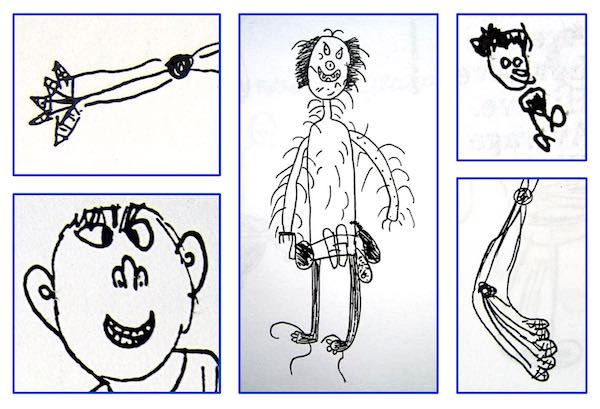
Az the previous part we closed with a question: what was Goodenough's brilliant error?
Let the answer follow! Let us take them in turn:
1. Why WAS HE A GENIUS?
Because he was ahead of his time in that from a drawing he tried to establish the child's intellectual development.
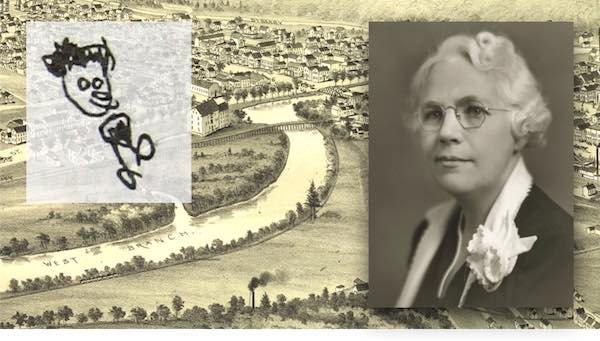
In the 1920s the measurement of intelligence was in its infancy. Psychologists struggled a great deal with it, and experimented with long questionnaires and complicated practical tasks.
Goodenough's method, however...
- was an original idea,
- children could be examined with it,
- it took only 10 minutes,
- it could be evaluated in 2 minutes,
- the children were glad of it,
- they did not even need to be able to read,
- it also worked with hearing-impaired children and children who did not know English.
It filled such a gap that it is not by chance that it became lightning-fast the 3rd most frequent psychological test.
It is still the best-known drawing test today. At most colleges, universities this is still taught now.
The test is still today a mandatory part of numerous routine examinations (e.g. school-readiness assessment).
2. What is THE MISTAKE IN IT?
Goodenough did not recognise (or did not treat it) the problem that the quality of the drawing is determined by other factors besides intelligence.
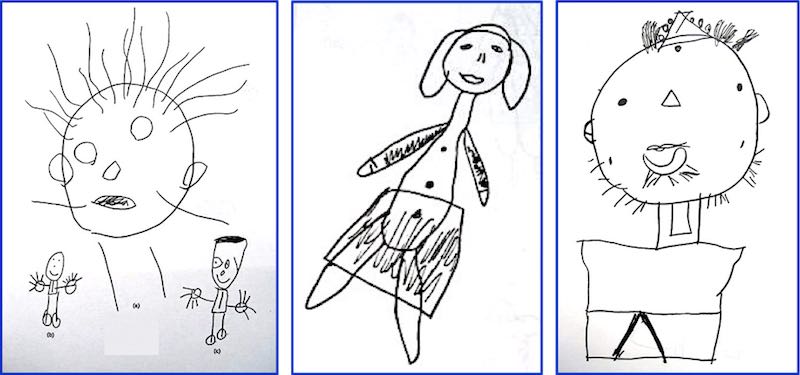
The numerical value of the Goodenough drawing quotient and the ABC scale is largely a function of the number of details depicted on the human figure.
The RQ essentially expresses the number of details of the human figure drawing. The more details there are in the drawing, the more points it receives.
But the drawing quotient (RQ) = intelligence quotient (IQ) formula is a simplification that in this form should no longer be taught today!
Wolfgang Sehringer, the excellent and thorough Heidelberg professor who deals with children's drawings, for example reviews 58 scientific publications examining the correlation of the Goodenough test with other intelligence measures.
Sehringer, W. (1999). Zeichnen und Spielen als Instrumente der psychologischen Diagnostik. Schindele, Heidelberg, pp. 324-327.
The results are unfortunately mixed; the correlations are unreliably low.
Indeed: according to the research, the value of the RQ within 24 hours may also change to such a degree as is ultimately irreconcilable with the RQ ~ IQ formula.
Click here if this interests you in more detail
Why is this so?
For drawings of deficient detailing may be created by causes other than an intelligence deficit too.
The FOUR most common causes:
- Partial abilities (for example fine motor skills) the delayed development of.
- Test resistance (he does not feel like cooperating).
- Situative factors (fatigue, impatience).
- Psychological problems, neurotic symptoms.
We here at The SSCA Method have long since ceased to use Goodenough's test (although all our respect is his).
Instead we use and teach something else: Elizabeth Münsterberg KOPPITZ his (1968, 1984) human figure drawing test.
Koppitz separated the drawing signs testifying to developmental delay and to emotional problems, because...
- 30 developmental indicators (signs)
- and 30 emotional indicators
...separated off.
With this he placed the human figure drawing test on a new footing:
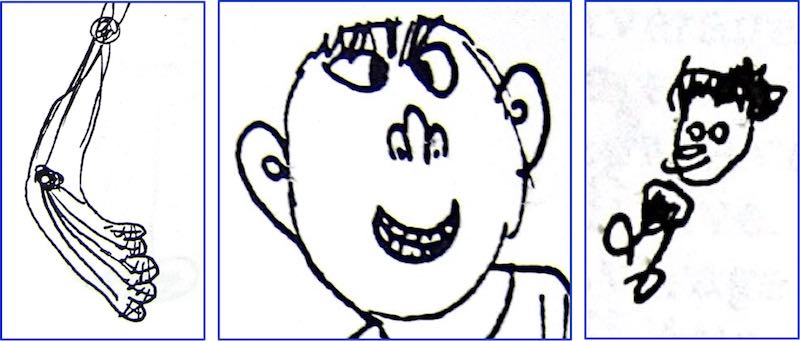
While the DEVELOPMENTAL INDICATORS its absence indicates a developmental lag or regression, the EMOTIONAL INDICATORS its appearance refers to neurotic disturbances.
This is a huge step compared with Goodenough's scale!
Among the emotional indicators Koppitz classed such drawing signals as...
- only with severe emotional problems occurred in children struggling with,
- their frequency at most 15% was in normal children,
- did not depend on the age.
The separation of developmental and emotional indicators is a more reliable method than Goodenough's test.
Moreover, it also helps to find out what emotional problems lie in the background.
Koppitz's test, unfortunately, FEW PEOPLE KNOW, yet its use is just as simple as that of the Goodenough test.
(We too rarely teach it at The SSCA Method because of our workload. Now, however, it features in the soon-to-start drawing-analysis lectures in its program. We hand over the list of developmental and emotional indicators to the participants, and also teach the use of the test.)
Cited literature sources (click here)
Free online lectures
Tuesday, 30 June 2026 we hold free, open lectures live starting at (in webinar form, with the Zoom application).
In the lectures Prof. Vass Zoltán gives an overview of modern projective drawing interpretation.
Afterwards we hold an Open Day, when questions can be asked.
Time:
2026.06.30.. 18:45
Programme:
17.00-17.30: Projective drawing interpretation lecture
Lectures combined with projection about children's drawings and the analysis of adults, with examples and drawings. The topic of the forthcoming lecture:
THE EMOTIONAL MAP OF THE HOME AS A METHOD OF PROJECTIVE DRAWING INTERPRETATION
From the lecture you will learn the exciting method of the emotional floor plan, with which it can be uncovered where the positive and negative emotions are localised in the home, how these can be changed and what they reveal about the personality.
You will also get an answer to why the house, the home, the flat and its furnishing act on people with such an intense and irresistible force.
Following the lectures, you too can incidentally make your own emotional map, which will be an irreplaceable treasure for you.
17.30-18.00: Open Day
- A brief introduction of The SSCA Method.
- A look inside: training courses, obtaining a certificate, test lab, library.
- The presentation of the internationally award-winning ARTIES drawing-analysis program in operation.
- Question, conversation.
Requesting a login link and password:
(c) 2020 The SSCA Method