This website uses cookies in order to operate the site, to make it easier to use, to track activity carried out on the site, and to display relevant offers.
Functional
Always active
The technical storage or access is strictly necessary for the legitimate purpose of enabling the use of a specific service explicitly requested by the subscriber or user, or for the sole purpose of carrying out the transmission of a communication over an electronic communications network.
Preferences
The technical storage or access is necessary for the legitimate purpose of storing preferences that are not requested by the subscriber or user.
Statistics
The technical storage or access that is used exclusively for statistical purposes.The technical storage or access that is used exclusively for anonymous statistical purposes. Without a subpoena, voluntary compliance on the part of your Internet Service Provider, or additional records from a third party, information stored or retrieved for this purpose alone cannot usually be used to identify you.
Marketing
The technical storage or access is required to create user profiles to send advertising, or to track the user on a website or across several websites for similar marketing purposes.
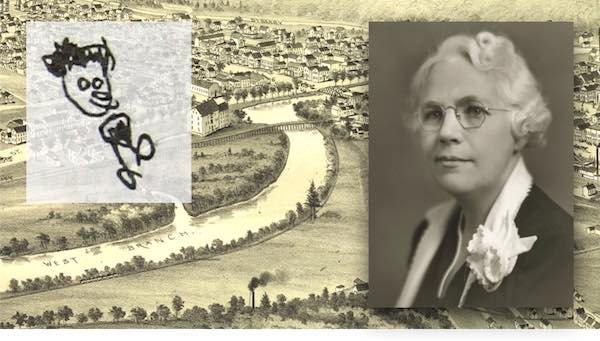
In the 1920s the measurement of intelligence was in its infancy. Psychologists struggled a great deal with it, and experimented with long questionnaires and complicated practical tasks.
Goodenough's method, however...
was an original idea,
children could be examined with it,
it took only 10 minutes,
it could be evaluated in 2 minutes,
the children were glad of it,
they did not even need to be able to read,
it also worked with hearing-impaired children and children who did not know English.
It filled such a gap that it is not by chance that it became lightning-fast the 3rd most frequent psychological test.
It is still the best-known drawing test today. At most colleges, universities this is still taught now.
The test is still today a mandatory part of numerous routine examinations (e.g. school-readiness assessment).
2. What is THE MISTAKE IN IT?
Goodenough did not recognise (or did not treat it) the problem that the quality of the drawing is determined by other factors besides intelligence.
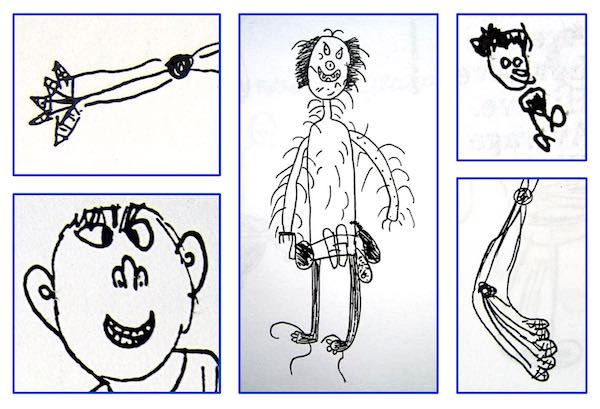
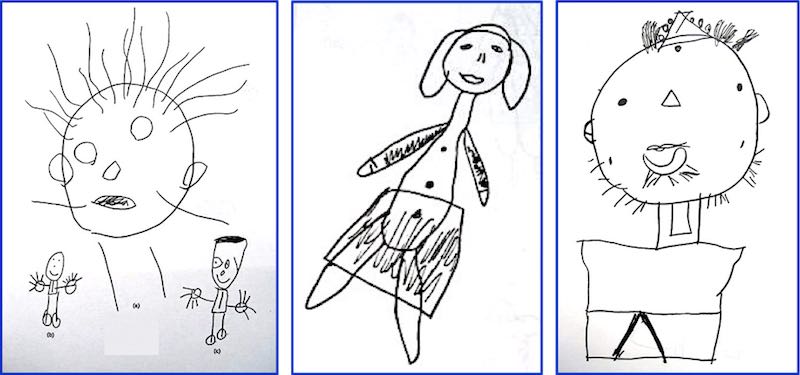
The numerical value of the Goodenough drawing quotient and the ABC scale is largely a function of the number of details depicted on the human figure.
The RQ essentially expresses the number of details of the human figure drawing. The more details there are in the drawing, the more points it receives.
But the drawing quotient (RQ) = intelligence quotient (IQ) formula is a simplification that in this form should no longer be taught today!
Wolfgang Sehringer, the excellent and thorough Heidelberg professor who deals with children's drawings, for example reviews 58 scientific publications examining the correlation of the Goodenough test with other intelligence measures.
Sehringer, W. (1999). Zeichnen und Spielen als Instrumente der psychologischen Diagnostik. Schindele, Heidelberg, pp. 324-327.
The results are unfortunately mixed; the correlations are unreliably low.
Indeed: according to the research, the value of the RQ within 24 hours may also change to such a degree as is ultimately irreconcilable with the RQ ~ IQ formula.
Click here if this interests you in detail too
The depictive standard of children's drawings can show dramatic fluctuation even on consecutive days.
KELLOGG (1969), for example, reports on an experiment in which primary-school children drew a person on five consecutive days, and the Goodenough drawing quotient of one third of the human drawings showed a surprising difference: a deviation of 50 per cent.
If a short time, for example only a few days, separates the drawings from each other, they will be more similar than if the elapsed time is longer.
In a psychometrically more thorough examination, RUBIN, SCHACHTER and RAGINS (1983) had 4- to 12-year-old children draw a person on two successive days, and then repeated the same a week later. The children's drawings made on successive days resembled one another more (r = 0.65) than those separated by a week (r = 0.54-0.57).
From the above study we also know that the drawings of primary-school-age boys are of more fluctuating quality than those of girls.
The variability, moreover, shows a cyclical pattern in both sexes: the drawings of the five-year-olds and ten-year-olds are the least similar, the drawings of the four-year-olds and eight-year-olds remain the most unchanged, the similarity of their visual appearance being globally judged, and from a content point of view (what type of person he drew), and from the point of view of the score measured on the Goodenough scale.
Alongside the observed general tendencies, however, the individual differences are very great; some children always draw the same kind of person, others quite different people (put numerically, the standard deviation of the similarity indices varies between 1.29 and 23.03).
The successive drawings of adults and adolescents may alike be very similar or very different, which is well interpretable from a diagnostic point of view.
Source: Vass, Z. (2006/2013). A rajzvizsgalat pszichodiagnosztikai alapjai. Projekcio, kifejezes, mintazatok. Budapest: Flaccus Kiado, p. 126.
Why is this so?
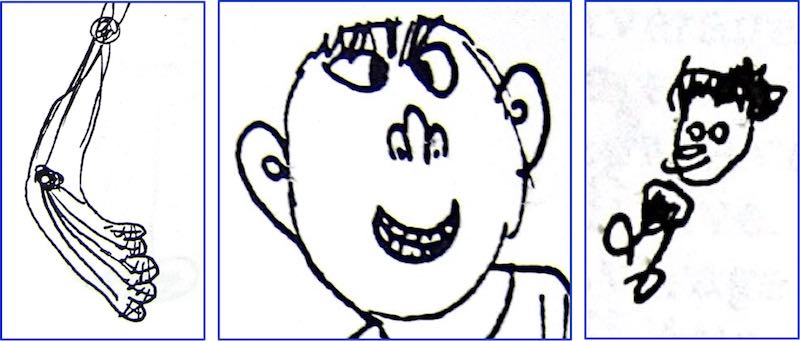
For drawings of deficient detailing may be created by causes other than an intelligence deficit too.
The FOUR most common causes:
Partial abilities (for example fine motor skills) the delayed development of.
Test resistance (he does not feel like cooperating).
Situative factors (fatigue, impatience).
Psychological problems, neurotic symptoms.
We here, the At The SSCA Method we have long since ceased to use Goodenough's test (although all our respect is his).
Instead we use and teach something else:Elizabeth MünsterbergKOPPITZ his (1968, 1984) human figure drawing test.
Koppitz separated the drawing signs testifying to developmental delay and to emotional problems, because...
30 developmental indicators (signs)
and 30 emotional indicators
...separated off.
With this he placed the human figure drawing test on a new footing:
While the DEVELOPMENTAL INDICATORS its absence indicates a developmental lag or regression, the EMOTIONAL INDICATORS its appearance refers to neurotic disturbances.
This is a huge step compared with Goodenough's scale!
Among the emotional indicators Koppitz classed such drawing signals as...
only with severe emotional problems occurred in children struggling with,
their frequency at most 15% was in normal children,
did not depend on the age.
The separation of developmental and emotional indicators is a more reliable method than Goodenough's test.
Moreover, it also helps to find out what emotional problems lie in the background.
Koppitz's test, unfortunately, FEW PEOPLE KNOW, yet its use is just as simple as that of the Goodenough test.
We too rarely teach it at The SSCA Method (because of our workload).
The two lists (the developmental and the emotional indicators) we hand out to the participants on the course, and we also teach the use of the test.
Cited literature sources (click here)
Koppitz, E. M. (1966) Emotional indicators on human figure drawings of children: a validation study. Journal of Clinical Psychology 22, 313-315
Koppitz, E. M. (1965). A comparison of pencil and crayon drawings of young children. Journal of Clinical Psychology, 21, 191-194.
Koppitz, E. M. (1966a). Emotional indicators on human figure drawings of children: a validation study. Journal of Clinical Psychology 22, 313-315
Koppitz, E. M. (1966b). Emotional indicators on human figure drawings of shy and aggressive children. Journal of Clinical Psychology 22, 466-469
Koppitz, E. M. (1968). Psychological Evaluation of Children's Human Figure Drawings. New York: Grune and Stratton.
Koppitz, E. M. (1969). Emotional indicators on human figure drawings of boys and girls from lower and middle-class backgrounds. Journal of Clinical Psychology, 25, 432-434.
Koppitz, E. M. (1984). Psychological Evaluation of Human Figure Drawings by Middle School Pupils. London: Grune and Stratton.