The emotional map of your home:
downloads
We put this page together after the SSCA Method webinar, at the request of the participants. It contains the downloads related to the talk, which may be useful more widely as well.
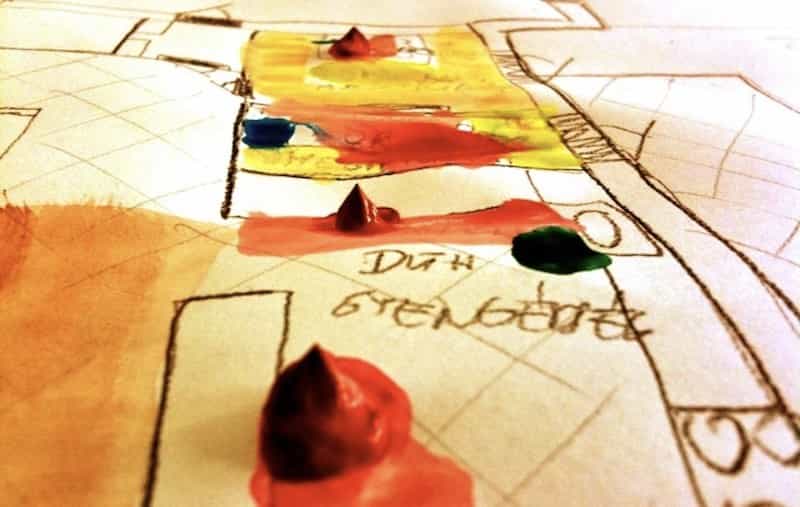
The webinar dealt with drawing the emotional map of the home, and demonstrated how the method is applied and interpreted, with pictorial examples and video recordings.
- “The home is like another being with whom we are going to live... It has qualities that we cannot change.
- If we force our will upon it, it is as if we were forcing it to play a role.
- Let us choose cooperation instead, and treat our peculiar «flatmate», the home itself, with respect and love!
- Let us sense the soul of the home, its individual nature!
- Let us walk through the space with a sensitive eye, and allow the home to affect us.
- One does a great deal for oneself by discovering, and then remembering, which part of the home affects one in which way..." (continued below)
A few words about the free talk series
The talk is part of the SSCA Method's free science-communication series.
The series is aimed primarily at professionals in the helping and caring fields.
Each time a different topic is covered, and every talk is given only once. Participation is free and open; we warmly look forward to seeing you at the next occasion (scroll down for the registration form)!
Here are the download links for the "emotional map of the home" topic:
- THE SOUL OF THE HOME. An expanding mini-universe, or a space-widening spell. An excerpt for internal use from an interview with Prof. Dr. Zoltán Vass. Click here to download (PDF)
- Read about the related research too, in Viola Sallay's PhD dissertation "Environmental-emotional self-regulation processes in the space of the family home" (2014)
English recording of this webinar is being prepared — this is the public SSCA Method preview.
IF YOU ARE LOOKING FOR IN-DEPTH TRAINING...
The SSCA Method's mission is the scientific research of projective drawing interpretation, and the spread of an objective, up-to-date outlook through scientific publications, conferences and training.
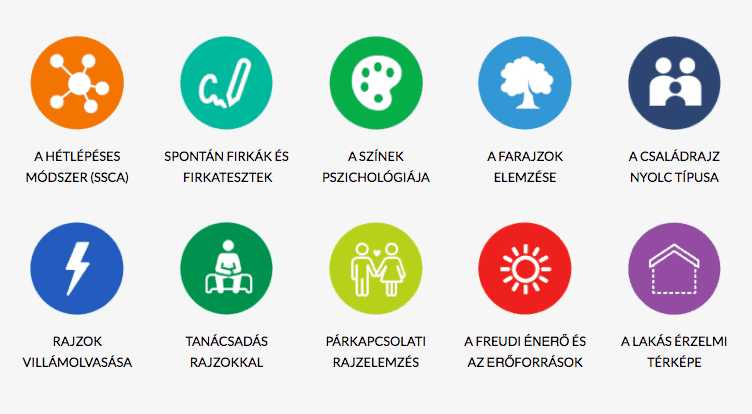
The most popular training is the Online Tutorial Program, which teaches 11 modern areas of picture interpretation, primarily for professionals in the helping and caring fields (or those preparing for such a career).
What does the Online Tutorial Program contain?
Chapters that teach the up-to-date body of knowledge of picture interpretation with instructional films, online exercises and online consultation. Their credibility is ensured by the fact that they were produced in a scientific research workshop.
The chapters
- consist of instructional films,
- contain built-in exercises,
- with downloadable supporting material,
- with self-administered knowledge-assessment tests,
- which are complemented by personal, online consultations.
A total of 24 topics
...cover the Seven-Step Configuration Analysis method, as well as the topics of scribbles, tree drawings, family drawings, colours, rapid picture reading, counselling, relationship picture interpretation and art-therapy techniques.
The scenes shown in the films were gathered through 25 years of scientific research work:
...cover the Seven-Step Configuration Analysis method, as well as
- scribbles,
- tree drawings,
- family drawings, school drawings, kindergarten drawings,
- colour psychology,
- rapid picture reading,
- counselling with drawings,
- relationship picture interpretation and
- the topics of art-therapy techniques.
- in genuine assessment situations, close-up filmed scribble tests, tree drawings, human-figure drawings and other subjects, where you can follow the movements, the pauses and the changes of psychomotor tempo from the first to the last second,
- a demonstration of Lundholm's 1921 experiment illustrating the affective meaning of the line,
- colour paintings made in an art-therapy session that depict the healthy and the pathological self,
- the psychological analysis of the colour choices of two Parisian painters, whose paintings made in Montmartre happened by chance to be recorded,
- a family-therapy case study for the colour Stora four-tree test, in which the tree drawings of the child, the mother and the alcoholic father reveal the concealed family pathology,
- a presentation of the "tree in a storm" crisis-diagnostic test based on patients' tree-drawing paintings,
- family drawings, kindergarten and school drawings from healthy and troubled children, filmed while being drawn, supplemented with explanations,
- projective mother-child drawings made by mothers living in a mother-and-baby home,
- the analysis of a police officer's animal-drawing test, which reveals why he is unsuited to that career,
- authentic life-space tests made in a children's home for uncovering attachment problems and separation experiences,
- a series of life-space tests of alcoholics and homeless people, whose maps make it immediately clear what matters most in a person's life, what drove them into their situation and what way out is taking shape,
- the peculiar scribbles and house-tree-person test of a schizophrenic patient, which speak clearly of the patient's experiences,
- the analysis of a complete life history with the internationally acclaimed new method, the Sixty-Second Drawing Test (SSDT),
- relationship diagnostics with the Sixty-Second Drawing Test, analysing real relationships,
- enlarged details of the drawing tests of borderline, manic-depressive, paranoid and other patients, which the professor analyses in detail,
... or those texts, unavailable elsewhere, from the archive of Prof. Dr. Zoltán Vass.
Click on the topic that interests you most:
The anatomy of the scribble and the line
Colour diagnostics
Traditional and new tree-drawing tests
Family drawing, kindergarten and school drawing
Counselling, coaching, therapy
Relationship diagnostics
Art therapy
WHY DO WE RUN THIS PROGRAM?
The SSCA Method's mission is the further development of the research field of pictorial expression psychology and credible science communication.
The science of picture interpretation has undergone enormous development in recent decades, as the new scientific paradigm of pictorial expression psychology emerged from the research of Prof. Dr. Zoltán Vass (on which he gave a plenary lecture at the Hungarian Psychological Association).
In more detail:
Vass Zoltán (2016). A képi kifejezéspszichológia új paradigmája – Mérei Ferenc emlékelőadás. Múlt and jelen összeér. Magyar Pszichológiai Társaság XXV., Jubileumi Országos Tudományos Nagygyűlése, Budapest, 2016.06.02-04. (2016.06.02.)
Some recommended reading:
Vass, Z. (2006). A rajzvizsgálat pszichodiagnosztikai alapjai. Budapest: Flaccus. (927 pp.)
Vass, Z. (2012). A psychological interpretation of drawings and paintings. The SSCA method: A systems analysis approach. Budapest: Alexandra. (928 pp.)
Vass, Z. (2011). A képi kifejezéspszichológia alapkérdései - szemlélet and módszer. Budapest: L’Harmattan
Unfortunately, in most institutions professionals still use outdated methods that represent the scientific standard of the 1950s.
These should no longer be used today.
As opposed to these superseded methods, the SSCA Method seeks to spread a modern, scientific outlook.
Addictive :)
An enormous amount of work to put together a training like this. Thank you.
Surprisingly good, exciting, humorous, to the point, understandable….
Although I have only listened to a few parts so far, it has been very exciting and understandable. I also like the way it was technically implemented.
I have wanted to get into this for a very long time! I am glad to be here, the first part was already very interesting. I look forward to the continuation with curiosity and excitement! Congratulations on the program!
Although I also like attending courses in person, which has a different atmosphere, I now see that a huge advantage of the videos is that I can return to anything if I want to understand or memorise it better. If I am interrupted or get tired, that is no big problem either, I can continue from there and then, whenever I want.
I am very glad that I found the most credible picture-interpretation course!
The amount is a little intimidating for me, but I hope I will manage to cope with it.
The lectures are very well edited.
We are still very much at the beginning (especially me, in working through it), but I would call it flawless.
High-level and comprehensive material, exceptional teachers, quality training, and all of this on my own schedule!
Really great, easy to understand, I love it.
The training is very good. I would listen to the lectures for much longer, because they are very enjoyable and informative.
All the examples the Professor presents are very interesting and useful to me.
Thank you that I can deepen my knowledge of picture interpretation even further and that the material becomes even clearer. It is very interesting and repeatable, which is also a great advantage.
Thank you very much for the opportunity to expand my knowledge further. I really like this kind of training, even though I had reservations at first because of gaps in my computer skills. But the system is very simple, and it really guides you through everything. I am grateful for it. Thank you for all your work. I wish you further success in your future work too.
I was kept continuously informed about the start of the training, and at the first topic I met such a well-organised program that I had no questions left.
I love that I can watch the videos anytime, as many times as I want. The professor explains the material very well. Based on what I have seen so far, I give the program top marks.
Nicely and clearly structured body of knowledge, very interesting and increasingly making me curious, because analysis is close to me (through my work, for 30 years).
I can only congratulate you on the compilation of the material and thank you for the opportunity to be part of this training!
The uploaded videos, exercises and the detailed materials with cited sources help a lot. I was especially glad about the case studies. Practical, so easier to understand. Thank you that I can take part in the training!
Congratulations on developing this training format that requires enormous work and professional expertise. The videos work well, can be paused and replayed multiple times.
I am grateful that I can learn the essentials in short videos. This is a great help, thank you!
The lecture is sensational! I especially like the division into small chapters and the many practical examples
I have only managed to watch the first few videos, but I find it practical that it can be paused, replayed, and repeated at will.
GREAT, I LOVE IT
I have watched relatively few parts so far. What is good about it is that it is not crammed with lots of factual material that is tiring to digest.
Knowing Zoltán Vass's professionalism, I had no doubt that this training would also contain lectures of high professional quality.
I have attempted the basic training several times before, and now I feel the picture is coming together.
SENSATIONAL! You really cannot describe this in one sentence. I have listened to many lectures already, but even alongside the repetition I got something new. It is like the end of a picture interpretation: we get its whole essence! The essential things are emphasised, it holds your focused attention throughout … so, sensational!!! Thank you!
I really like the training! My only regret is that, alongside work, I cannot spend as much time on it as I would like. I would happily watch the materials all at once, and several times a day. I owe nothing but thanks to the whole team who made this experience possible for me. I wish you strength, health and perseverance for your further work! Thank you again for the opportunity.
It is very serious and the amount caused me a little fright too. While I watched the video segments, listened and solved the exercises in them, all my tension definitely eased. It is very good that I can listen to the material. This kind of “personal touch” helps a lot.
The training is very interesting; for me it means the renewal of my professional work.
First of all I would like to say thank you that I can take part in such a wonderful training! Honestly, I was afraid of how this would go for me, but the videos are understandable and I can look up any concept new to me in the literature
Overall I like it very much, a truly high-quality course, and I hope I can keep up alongside my 5-month-old baby too. With regards and all my appreciation!
Very fair and comprehensive. From here on it depends on my own effort whether I manage to master the material.
I really like it. Well put together, edited with variety, entertaining and substantial. I also like very much that I can pause it and replay it many times if something is unclear. And for this you really have to work at home too.. – but I think it will be worth it. Thank you for the opportunity!
You can see that it is a well-thought-out, professionally structured teaching material. I think I will learn a great deal from it and have a good time in the process
A fantastically compiled, high-quality, understandable and enjoyable material.
Addictive :)
An enormous amount of work to put together a training like this. Thank you.
Surprisingly good, exciting, humorous, to the point, understandable….
Although I have only listened to a few parts so far, it has been very exciting and understandable. I also like the way it was technically implemented.
I have wanted to get into this for a very long time! I am glad to be here, the first part was already very interesting. I look forward to the continuation with curiosity and excitement! Congratulations on the program!
Although I also like attending courses in person, which has a different atmosphere, I now see that a huge advantage of the videos is that I can return to anything if I want to understand or memorise it better. If I am interrupted or get tired, that is no big problem either, I can continue from there and then, whenever I want.
I am very glad that I found the most credible picture-interpretation course!
The amount is a little intimidating for me, but I hope I will manage to cope with it.
The lectures are very well edited.
We are still very much at the beginning (especially me, in working through it), but I would call it flawless.
High-level and comprehensive material, exceptional teachers, quality training, and all of this on my own schedule!
Really great, easy to understand, I love it.
The training is very good. I would listen to the lectures for much longer, because they are very enjoyable and informative.
All the examples the Professor presents are very interesting and useful to me.
Thank you that I can deepen my knowledge of picture interpretation even further and that the material becomes even clearer. It is very interesting and repeatable, which is also a great advantage.
Thank you very much for the opportunity to expand my knowledge further. I really like this kind of training, even though I had reservations at first because of gaps in my computer skills. But the system is very simple, and it really guides you through everything. I am grateful for it. Thank you for all your work. I wish you further success in your future work too.
ROUND-THE-CLOCK PROFESSIONAL SUPPORT FOR PARTICIPANTS
For the participants of the SSCA Method's training we created an online forum where you can ask professional questions in a closed Facebook group. Since notifications about questions and messages arrive instantly, the members of the forum or our staff can answer immediately or within a few hours.
We run the forum because it lets us provide continuous support and help for the members' professional development.
© Copyright 1995-2026 The SSCA Method | Founded by: Prof. Dr. Zoltán Vass | For questions, contact us at support@sscamethod.com | Log in